Showing posts with label Reviews. Show all posts

Friday, April 15, 2011

Facing Life's Ups and Downs -- Review

FACING LIFE’S UPS AND DOWNS: The Struggle to be Whole. By William Powell Tuck. Macon: Smyth & Helwys Publishing, 2010. 180 pages.

Somewhere I remember reading something like this: “It’s the daily stuff of life that makes living so tough.” That is precisely why this book can be a valuable resource for dealing with the inevitable: the ups and downs that come to all of us regardless of our situation in the human family.

Tuck addresses a wide variety of issues with sound biblical exegesis of texts, personal anecdotes, excellent illustrations, and much healthy humor. All of which are absolutely necessary when one is dealing with stress, anger, anxiety, depression, loneliness, failure, and frustration. Although countless books have been written on each of these subjects, this book presents keen and succinct insights into issues that cloud some (many?) of our days. It also reveals a deep understanding of complex problems that are dealt with in a clear and concise manner.

One of the things I most appreciated is the profound simplicity one finds in these pages. (And don’t ignore the word profound.) One is not required to have attended a seminary or passed a course in psychology to be able to gain the benefits this book offers. The writing is certainly a “good read” as the reader is led to a clear understanding of each issue under discussion. You never have to ask, “I wonder what he means by that?”

This is in no way a general “self-help” book. It is all about how our Christian faith relates to life as we know it and live it. Biblical references abound; the application of these texts is succinctly and carefully spelled out. Without being dogmatic or judgmental, the author challenges us to live our Monday through Saturday lives in the light of our Sunday affirmations of faith.

One of the most helpful aspects of this book is the vast array of suggestions for dealing with each of the “downs” discussed. These suggestions are practical and within reach of all of us. Many of them are simply reminders of what we already know but have failed to put into practice. I cannot imagine anyone who does not need such reminders.

While excellent for personal reading, this book is a splendid resource for discussion groups of all kinds. Sunday school classes immediately come to mind but I also think it would be very usable in home study groups where some of the participants are not particularly church oriented. Most people have never had the opportunity to discuss openly and honestly the subjects covered.

After reading the Bible through for the first time, a late-in-life convert confessed: “I found myself on every page except for the ‘begats.’” I will confess that I found myself on almost every page of Tuck’s book. I appreciate the honesty in his writing that does not ignore the dark and inevitable side of life – even for the Christian. But he does not leave us with the “downs.” His constant encouragements to faith (trust) and recommendations for activities and practices for life when it is low really will enable us to make genuine progress in the struggle to be whole.


Ron Higdon,
Cooperative Baptist Fellowship
Prospect, Kentucky


Originally published in the Spring issue of Sharing the Practice.

Ultimate Allegiance -- Review

Ultimate Allegiance: The Subversive Nature of the Lord’s Prayer. By Robert D. Cornwall. Gonzalez, Florida: Energion Publications, 2010. 65 pages.

The writer of Ultimate Allegiance is Robert Cornwall, the Pastor of Central Woodward Christian Church in Troy, Michigan and the Editor-in-Chief of Sharing the Practice. To be honest, when I first picked up this new book on the Lord’s Prayer, having read dozens of books on the Lord’s Prayer and having written a book on the Lord’s Prayer myself, I wondered if I could find anything new or different about it. I was soon pleasantly surprised and stimulated to find within these brief pages many fresh and challenging insights. This book is based on a six-part sermon series, which Cornwall delivered in his own church to probe the question: what was he and the congregation praying each week and what did Jesus really intend for his followers to take from this prayer? As beautiful and inspiring as most people feel from praying the Lord’s Prayer, Cornwall believes that at its essence it is a very subversive prayer. Subversive prayer is prayer that engages “the powers that be.”

Cornwall notes the differences in the Lord’s Prayer in the two gospels, Matthew and Luke, and the differences in meaning of the words in the prayer according to the context and purpose of each. In six chapters he examines the declaration and petitions that form the prayer, he believes, “serve as an affirmation of God’s reign.” In the first petition he prefers the Greek word in the text for father, pater, which provides the root for words like patron and patriarch, and fits the “subversive” challenge which calls for our allegiance to God our Father over all other powers. The “our” Father reminds us of our corporate relationship to God, which is not a private or personal one, but is a part of the family of God--the Kingdom of God. The concept of the holiness of God helps us qualify our understanding of what it means to be in a relationship with the God who reigns over all and requires ultimate allegiance. He asserts boldly that the petition about praying for the coming kingdom is not a minor focus but is a reminder that the kingdom is at the center of the teachings of Jesus. This petition about praying for the kingdom to come is subversive in that it is not only a religious and spiritual declaration but a political one as well that declares God reign on Caesar’s throne or on any throne of power to bring about justice. This involves the willingness to say no to Caesar’s claim on one’s life and acknowledge our dependence on God.

The petition about our daily bread is a recognition that we must attend to our basic needs before we voice any others. The subversive dimension of this petition is the affirmation that we entrust God to provide for our needs not Caesar or government. Ultimately God is our provider and we declare our allegiance to him and humbly acknowledge our lack of self-sufficiency. “Our” bread affirms our solidarity with our neighbors and our willingness to share our bounty with them. This comes as a radical demand which, he knows, will be hard for many of us to embrace. In the petition on forgiveness he examines the three variants-one’s debts, sins or trespasses- with helpful insights. Acknowledging that trespass may not have textual support, he believes that it fits the subversive nature of the prayer, if we take the word in the modern sense to cross boundaries and invade spaces. He also reminds us that in this prayer Jesus states that forgiveness involves reciprocity. It is never enough simply to receive God’s forgiveness, we are charged to offer forgiveness to someone who has hurt or offended us. The prayer regarding temptation becomes culturally and socially subversive, according to Cornwall, when it becomes the foundation for discernment. In our journey through life many temptations will call for our allegiance but adhering to God’s reign means nor giving in to those voices and continuing the journey even when the way is difficult with the assurance of God’s presence with us. The doxology and affirmation about God’s glory confesses God’s power to transform the world as a power of love and relatedness and not by coercion or violence as evidence in the cross of Jesus.

This book can be used by ministers or lay persons for a devotional guide to the Lord’s Prayer, reading a chapter a day to deepen their understanding of this rich prayer. Churches could use it as a resource in prayer and book studies. Pastors could study it and draw on it as a model for preaching a series of sermons on the Lord’s Prayer. They might follow Cornwall’s model and have the congregation sing the prayer instead of reciting it. I personally found it a thought provoking experience that forced me to reexamine the various petitions in this model prayer of Jesus. I commend it highly and hope many will discover and read and use it to grow in their awareness of this special prayer.


William Powell Tuck, FAPC
Intentional Interim Pastor
Cool Spring Baptist Church
Mechanicsville, Virginia

Friday, April 30, 2010

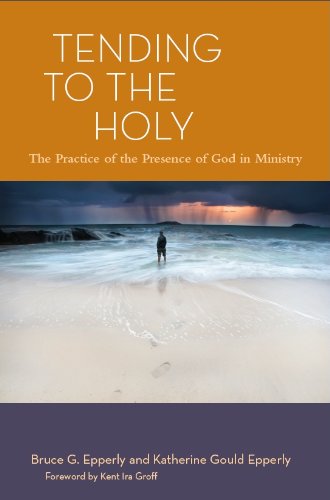
Tending to the Holy -- Book of the Year reviewed

I wanted to announce that the book Tending to the Holy, written by Bruce and Kate Epperly, has been named Book of the Year by the Academy of Parish Clergy. This book, along with nine others, was be honored at the upcoming Academy of Parish Clergy Annual Meeting in Racine, WI. I happen to be the editor of the Academy's journal, Sharing the Practice.  Below is my review published originally at the blog Ponderings on a Faith Journey -- a briefer version was published in the journal.
______________________________________


TENDING TO THE HOLY: The Practice of the Presence of God in Ministry. By Bruce G. Epperly and Katherine Gould Epperly. Foreword by Kent Ira Goff. Herndon, VA: Alban Institute, 2009. xii + 196 pp.

Busy pastors often take little time to attend to their physical, emotional, or spiritual life. They also often compartmentalize parts of their ministry – assuming that some parts are spiritual (preaching and praying) and others not so spiritual (administration). Bruce and Kate Epperly pick up on Brother Lawrence’s imagery of “practicing the presence of God” and share their understanding of how all aspects of ministry are spiritual and need to be undertaken in prayer – whether that prayer is a breath prayer or time spent in contemplation and meditation. For those of us, who are not by nature contemplative, who find it difficult not just to take time but to feel comfortable in prayer, this book is a godsend.

The Epperlys co-pastor a Disciples/UCC federated church in Pennsylvania, while Bruce serves as Director of Continuing Education and Professor of Practical Theology at Lancaster Theological Seminary. This book is very personal, drawing on their experiences of ministry and spirituality. They write with passion about ways in which renewed and energized pastors can help energize mainline churches – not by turning to conservative theology, but by fully engaging a progressive understanding of Christianity. But, this is not rationalistic approach – they understand the need for the mystical, for letting the Spirit move in the life of the pastor and the church. This is an expression of the idea of Christian Practices that Diana Butler Bass, among others, have been lifting up these past several years, calling on us to a practice of awareness of God’s presence in every moment of our lives.

What is important to note here is that the Epperlys are strongly grounded in theology. They write:

While we recognize a good deal of truth in the postmodern critique of any attempt to frame global and all-inclusive theological worldviews, we nevertheless affirm the value of articulating a coherent, yet tentative and flexible, theological vision of God’s activity in the world as a means of orienting our lives and daily spiritual practices. (P. 11).


They acknowledge up front that they have been influenced by process theology, along with Jungian psychology and system theory, among others. These foundations are evident throughout, but they point us not to the systems and perspectives, but to practices that are deeply grounded and empower ministry. Perhaps most importantly, and this view they take from process theology, is the affirmation that God is always present. This a view that is continually reinforced. With that in mind, then we can integrate all aspects of life, and understand everything we do in ministry is rooted in God’s active presence in the world. They speak often, as well, of the principle of abundance – not in a prosperity gospel way – that allows us to see the world in a new light, one that is not rooted in scarcity and fear.

The book takes up all facets of ministry, beginning with preaching, teaching and worship – and they define these aspects of ministry in terms of spiritual formation. They encourage taking time for study and prayer, so that in our teaching and preaching and worship leadership, we have a vision of God’s presence and a recognition that we are vessels through which God is speaking. One way of moving in this direction is to reclaim the use of study for the pastor’s office. They write that the use of office reflects a change from the ministerial vocation as that of “rabbi, teacher, and spirit person,” and has moved it into more corporate senses as “administrator, program manager, professional counselor, and functional CEO.” It’s not these functions aren’t part of ministry, but rather the problem of these images defining what a pastor is doing (pp. 36-37).

Moving from what would seem to be the most visible aspects of ministry, they move onto ministries of spiritual guidance, pastoral care, leadership and administration, and finally prophetic hospitality. In each area of ministry, they urge pastors to engage themselves spiritually and prayerfully, even when engaging in work that doesn’t seem all that spiritual. For clergy who resist the administrative tasks, they Epperlys remind us that we can’t get away from them, they’re part of what we do, but we can reenvision these tasks spiritually. The question they ask of us is this:

Will your administrative leadership deepen the spirituality of your congregation and your own spirituality, or will it be a source of conflict, fatigue, and frustration both for yourself and for the congregation? We believe that the form and style of your leadership and administration as a pastor cannot be separated from your theological beliefs and spiritual practices. (p. 127).


The kind of leadership they envision is one that is “creative, appreciative, affirmative, and imaginative.” It is a form of ministry that is rooted in a spiritual practice, which they borrow from Gerald May, of “pausing, opening, noticing, stretching and yielding, followed by responding to God’s presence.” This form of prayerfulness or mindfulness is described and applied throughout the book – reminding us how we might recognize God’s presence and engage that presence in all aspects of ministry.

The penultimate chapter is called “prophetic hospitality,” and this chapter needs to be internalized by mainline progressive pastors – many of whom pastor churches that are at a different place than they are when it comes to political, theological, social, and cultural issues. Clergy tend to either hide their views or lashing out angrily. The Epperlys offer another way, one that allows both for expressing prophetic understandings while respecting and loving those with whom we differ. The key is staying in relationship with those who differ, while continuing to hold true to one’s own beliefs.

Prophetic hospitality is grounded in a visionary reconciliation in which pastors see and appreciate Christ’s presence in all their congregants as the foundation of common ground amid great diversity. (p. 170)

Indeed, one cannot preach God’s love while disrespecting one’s opponents – a word that is difficult for us, as human beings, to get a hold of and internalize, and yet it’s an important one. Once again, however, in order to accomplish this, one must engage the other prayerfully. This conversation helpfully deals with the reality that is most troubling for us as pastors – dealing with our own anger. They offer a possible way for this anger to be transformed into love. In all of this, the point is that we seek a balance where we can live out our dual callings to be prophets and shepherds, challengers and comforters.

This is not only an excellent book, I would suggest that it is essential reading for clergy, especially those who are progressive in their theology. It is thoroughly grounded in theology, because the authors insist that what we believe matters -- especially regarding the presence of God in every aspect of life. They also take into account other sources of revelation – such as tradition and psychology It is challenging and comforting. The point is, our ability to live out our calling without becoming burned out and beaten up, requires that we stay grounded in our relationship with God, and that means practicing the presence of God in all places and at all times. Such a word breathes grace into our ministries.