Monday, October 25, 2010

Martin Marty to Speak at the Academy of Parish Clergy Annual Meeting

The Academy of Parish Clergy’s
2011 Annual Conference

presents

Building Trust in a Culture of Distrust

with

Rev. Martin Marty

February 15-17, 2011    Canterbury Retreat Center   Orlando, Florida

“Our society is experiencing a huge amount of distrust in our institutions. We distrust and are distressed with our financial institutions, our churches, our national leaders and other elements of our society. These issues are shaking our foundations. What is the role of the Church in addressing this climate of distrust?”  - Rev. Martin Marty

Church historian and Professor Emeritus at the University of Chicago, Rev. Martin Marty is highly respected as a religious historian, writer, theologian and pastor. He is a columnist for The Christian Century and an author of over 50 books as well as over 5000 articles, essays, and papers. Rev. Marty was ordained in 1952 and served churches in the Chicago suburbs for 10 years before joining the faculty at the University of Chicago where he taught for 35 years. He is a recipient of numerous awards, including the National Humanities Medal and the National Book Award.

Registration fees are $230 for clergy and $200 for spouses, if registered by January 10, 2011. After January 10, add $20. For single occupancy rooms add $75. Registration includes 2 nights double-occupancy accommodations and Tuesday noon through Thursday morning meals. Commuting attendees’ fee is $100 (includes meals). Anyone wishing to stay additional nights may make individual arrangements for a private retreat by contacting Terra Medeiros, Canterbury Director of Guest Services at (407) 365-5571 ext. 13.

For complete conference information and to obtain a registration form, go to http://www.apclergy.org/. You may alsocontact Rev. Paul Binder, Administrative VP, at pjbinder2@juno.com or (941) 922-8633.

Canterbury Retreat and Conference Center, a mission and ministry of the Episcopal Diocese of Central Florida, offers a sanctuary of hospitality for growth and learning. All room accommodations are motel-type and are nonsmoking.

Handicapped-accessible rooms are available. More information can be found at http://www.canterburyretreat.org/.

Friday, April 30, 2010

Tending to the Holy -- Book of the Year reviewed

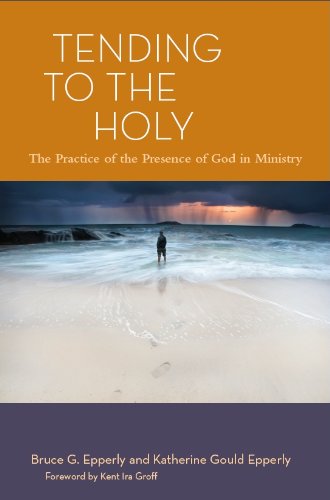
I wanted to announce that the book Tending to the Holy, written by Bruce and Kate Epperly, has been named Book of the Year by the Academy of Parish Clergy. This book, along with nine others, was be honored at the upcoming Academy of Parish Clergy Annual Meeting in Racine, WI. I happen to be the editor of the Academy's journal, Sharing the Practice.  Below is my review published originally at the blog Ponderings on a Faith Journey -- a briefer version was published in the journal.
______________________________________


TENDING TO THE HOLY: The Practice of the Presence of God in Ministry. By Bruce G. Epperly and Katherine Gould Epperly. Foreword by Kent Ira Goff. Herndon, VA: Alban Institute, 2009. xii + 196 pp.

Busy pastors often take little time to attend to their physical, emotional, or spiritual life. They also often compartmentalize parts of their ministry – assuming that some parts are spiritual (preaching and praying) and others not so spiritual (administration). Bruce and Kate Epperly pick up on Brother Lawrence’s imagery of “practicing the presence of God” and share their understanding of how all aspects of ministry are spiritual and need to be undertaken in prayer – whether that prayer is a breath prayer or time spent in contemplation and meditation. For those of us, who are not by nature contemplative, who find it difficult not just to take time but to feel comfortable in prayer, this book is a godsend.

The Epperlys co-pastor a Disciples/UCC federated church in Pennsylvania, while Bruce serves as Director of Continuing Education and Professor of Practical Theology at Lancaster Theological Seminary. This book is very personal, drawing on their experiences of ministry and spirituality. They write with passion about ways in which renewed and energized pastors can help energize mainline churches – not by turning to conservative theology, but by fully engaging a progressive understanding of Christianity. But, this is not rationalistic approach – they understand the need for the mystical, for letting the Spirit move in the life of the pastor and the church. This is an expression of the idea of Christian Practices that Diana Butler Bass, among others, have been lifting up these past several years, calling on us to a practice of awareness of God’s presence in every moment of our lives.

What is important to note here is that the Epperlys are strongly grounded in theology. They write:

While we recognize a good deal of truth in the postmodern critique of any attempt to frame global and all-inclusive theological worldviews, we nevertheless affirm the value of articulating a coherent, yet tentative and flexible, theological vision of God’s activity in the world as a means of orienting our lives and daily spiritual practices. (P. 11).


They acknowledge up front that they have been influenced by process theology, along with Jungian psychology and system theory, among others. These foundations are evident throughout, but they point us not to the systems and perspectives, but to practices that are deeply grounded and empower ministry. Perhaps most importantly, and this view they take from process theology, is the affirmation that God is always present. This a view that is continually reinforced. With that in mind, then we can integrate all aspects of life, and understand everything we do in ministry is rooted in God’s active presence in the world. They speak often, as well, of the principle of abundance – not in a prosperity gospel way – that allows us to see the world in a new light, one that is not rooted in scarcity and fear.

The book takes up all facets of ministry, beginning with preaching, teaching and worship – and they define these aspects of ministry in terms of spiritual formation. They encourage taking time for study and prayer, so that in our teaching and preaching and worship leadership, we have a vision of God’s presence and a recognition that we are vessels through which God is speaking. One way of moving in this direction is to reclaim the use of study for the pastor’s office. They write that the use of office reflects a change from the ministerial vocation as that of “rabbi, teacher, and spirit person,” and has moved it into more corporate senses as “administrator, program manager, professional counselor, and functional CEO.” It’s not these functions aren’t part of ministry, but rather the problem of these images defining what a pastor is doing (pp. 36-37).

Moving from what would seem to be the most visible aspects of ministry, they move onto ministries of spiritual guidance, pastoral care, leadership and administration, and finally prophetic hospitality. In each area of ministry, they urge pastors to engage themselves spiritually and prayerfully, even when engaging in work that doesn’t seem all that spiritual. For clergy who resist the administrative tasks, they Epperlys remind us that we can’t get away from them, they’re part of what we do, but we can reenvision these tasks spiritually. The question they ask of us is this:

Will your administrative leadership deepen the spirituality of your congregation and your own spirituality, or will it be a source of conflict, fatigue, and frustration both for yourself and for the congregation? We believe that the form and style of your leadership and administration as a pastor cannot be separated from your theological beliefs and spiritual practices. (p. 127).


The kind of leadership they envision is one that is “creative, appreciative, affirmative, and imaginative.” It is a form of ministry that is rooted in a spiritual practice, which they borrow from Gerald May, of “pausing, opening, noticing, stretching and yielding, followed by responding to God’s presence.” This form of prayerfulness or mindfulness is described and applied throughout the book – reminding us how we might recognize God’s presence and engage that presence in all aspects of ministry.

The penultimate chapter is called “prophetic hospitality,” and this chapter needs to be internalized by mainline progressive pastors – many of whom pastor churches that are at a different place than they are when it comes to political, theological, social, and cultural issues. Clergy tend to either hide their views or lashing out angrily. The Epperlys offer another way, one that allows both for expressing prophetic understandings while respecting and loving those with whom we differ. The key is staying in relationship with those who differ, while continuing to hold true to one’s own beliefs.

Prophetic hospitality is grounded in a visionary reconciliation in which pastors see and appreciate Christ’s presence in all their congregants as the foundation of common ground amid great diversity. (p. 170)

Indeed, one cannot preach God’s love while disrespecting one’s opponents – a word that is difficult for us, as human beings, to get a hold of and internalize, and yet it’s an important one. Once again, however, in order to accomplish this, one must engage the other prayerfully. This conversation helpfully deals with the reality that is most troubling for us as pastors – dealing with our own anger. They offer a possible way for this anger to be transformed into love. In all of this, the point is that we seek a balance where we can live out our dual callings to be prophets and shepherds, challengers and comforters.

This is not only an excellent book, I would suggest that it is essential reading for clergy, especially those who are progressive in their theology. It is thoroughly grounded in theology, because the authors insist that what we believe matters -- especially regarding the presence of God in every aspect of life. They also take into account other sources of revelation – such as tradition and psychology It is challenging and comforting. The point is, our ability to live out our calling without becoming burned out and beaten up, requires that we stay grounded in our relationship with God, and that means practicing the presence of God in all places and at all times. Such a word breathes grace into our ministries.


2010 Academy of Parish Clergy Book of the Year List

The Academy of Parish Clergy, Inc. announces the 2010 Book of the Year Award to be Tending To The Holy: The Practice of the Presence of God in Ministry by Bruce G. Epperly and Katherine Gould Epperly (Alban Institute). The Book of the Year Award is given to the best book published for parish ministry in the previous year. In addition, the Reference Book of the Year Award is given to Revelation: A Commentary in The New Testament Library by Brian K. Blount (Westminster/John Knox Press). These awards were presented at at the Annual Conference of the Academy, April 20-22, 2010, at the Sienna Center, in Racine, Wisconsin.

____________________

In addition to the Book of the Year, the Academy has selected the following books to complete its list of the Top Ten Books for Parish Ministry published in 2009. These appear in no specific order.


A People’s History of Christianity: The Other Side of the Story by Diana Butler Bass (HarperOne)

At the Scent of Water: The Ground of Hope in the Book of Job by J. Gerald Janzen (William B. Eerdmans Publishing Company)

Beyond the Yellow Ribbon: Ministering to Returning Combat Veterans by David A. Thompson (Abingdon Press)

Kindling Desire For God: Preaching As Spiritual Direction by Kay L. Northcutt (Fortress Press)

Preaching From Memory to Hope by Thomas G. Long (Westminster/John Knox Press)

The Future of Faith by Harvey Cox (HarperOne)

The Power to Comprehend With All the Saints: The Formation and Practice of a Pastor-Theologian ed. by Wallace M. Allston Jr. and Cynthia A. Jarvis (William B. Eerdmans Publishing Company)

The Ten Commandments (Interpretation Resources for the Use of Scripture in the Church) by Patrick D. Miller (Westminster/John Knox Press)

Toxic Spirituality: Four Enduring Temptations of Christian Faith by Eric W. Gritsch (Fortress Press)
 
Republished from:  Ponderings on a Faith Journey

Friday, May 16, 2008

Natural Church Development

Dr. David Daubert was the featured presenter at the 2008 Academy of Parish Clergy Annual Meeting. Below is a description of the Natural Church Development program and contact information.

***********************************


Churches have a tendency to become focused on fruit - growing attendance, dynamic programs, funded budgets, expanding facilities. In this pursuit, it is often forgotten that the root produces the fruit. Abundant fruit can only grow from a healthy root system.

Natural Church Development provides a reliable survey tool for measuring the health of your church in eight critical areas. These Quality Characteristics have proven themselves essential in building healthy churches.
--Empowering Leadership
--Gift-oriented Ministry
--Passionate Spirituality
--Functional Structures
--Inspiring Worship Services
--Holistic Small Groups
--Need-oriented Evangelism
--Loving Relationships

All eight of the Quality Characteristics are needed for a healthy church. Just as a person cannot live by bread alone, a church cannot grow to health on any one quality.

Natural Church Development also relies on six principles of growth to facilitate the health and growth in these quality areas:

--Interdependence
--Multiplication
--Energy transformation
--Multi-usage
--Symbiosis
--Functionality

These six principals are often referred to as Biotic Principles because they release the church's ability to grow all by itself. Together, these eight qualities and six Biotic Principles provide potent tools for bringing health and growth to your church.

Natural Church Development and the Church Growth Movement have large areas of overlap, yet are different. One of the major differences between the two can be highlighted in the area of quantitative versus qualitative goal setting. In NCD the quality of a church is the root, the quantitative growth the fruit. Growth in quantity is not the strategic goal of NCD, but a natural consequence of a healthy church.

Dr. David Daubert, a consultant in NCD, was the major presenter as the Academy of Parish Clergy's 2008 Annual Conference (Cleveland, OH, April 29-May1).

Tuesday, March 18, 2008

Academy of Parish Clergy -- 2008 Book of the Year

The Academy of Parish Clergy, Inc. announces the 2008 Book of the Year Award to be God’s Ambassadors: A History of the Christian Clergy in America by E. Brooks Holifield (William B. Eerdmans Publishing Company). The Book of the Year Award is given to the best book published for parish ministry in the previous year.

In addition, the Reference Book of the Year Award is given to Empire: The Christian Tradition, New Readings of Classical Theologians ed. by Kwok Pui-lan, Don H. Compier, and Joerg Rieger (Fortress Press).

These awards will be made at the Annual Conference of the Academy, April 22-23, 2008, at the Jesuit Retreat House, Cleveland, OH.

In addition to the Book of the Year, the Academy has selected the following books as the Top Ten Books for Parish Ministry published in 2007.

E Brooks Holifield. God’s Ambassadors: A History of the Christian Clergy in America. William B. Eerdmans Publishing Company -- Book of the Year

The remainder of the list, alphabetically by author:

Gerald W. Calabash, Editor. Just Policing, Not War: An Alternative Response to World Violence. Liturgical Press.

Pamela Couture Child Poverty: Love, Justice, and Social Responsibility. Chalice Press.

John Dominic Crossan, God and Empire: Jesus Against Rome, Then and Now. HarperSanFrancisco Publishers. -- reviewed by Robert Cornwall, Winter 2007, Sharing the Practice.

Antony Flew. There Is A God: How the World’s Most Notorious Atheist Changed His Mind. HarperOne Publishers.

Eugene Peterson The Jesus Way: A Conversation of the Ways That Jesus Is The Way. William B. Eerdmans Publishing Company

Alister McGrath. Christianity’s Dangerous Idea: The Protestant Revolution - A History from the Sixteenth Century to the Twenty-First. HarperOne Publishers.

Ben Quash and Michael Ward, Heresies and How To Avoid Them: Why It Matters What Christians Believe. Hendrickson Publishers.

G. Lloyd Rediger. The Toxic Congregation: How To Heal the Soul of Your Church. Abingdon Press.

Larry Witham. A City Set On A Hill: How Sermons Changed the Course of American History. HarperOne Publishers.

Thursday, December 13, 2007

Sharing the Practice -- Winter Contents

The Winter issue, the last of 2007, is in the mail. Here is a listing of the articles and reviews -- author, title, reviewer.

The focus of the articles in this issue is preaching.

********

Articles
  • Preaching Re-Imagined, Doug Pagitt 3
  • "Is There any Sorry Like My Sorry?" Jerry Gladson, APC 5
  • Paul Tillich as Preacher, Courtney Wilder, 8
  • Writing Our Way Home in Teaching, Preaching, and Soul Tending, Kent Groff, APC 11

Reviews
  • John Killinger, Enter Every Trembling Heart, William Tuck, APC 20
  • John Killinger, God, the Devil, & Harry Potter, William Tuck, APC 20
  • John Killinger, Ten Things I Learned Wrong from a Conservative Church, William Tuck, FAPC 21
  • James Nieman and Thomas Rogers, Preaching to Every Pew, William Tuck, FAPC 21
  • Jon Meacham, American Gospel, Lawton Posey, FAPC 21
  • William Tuck, Christmas is for the Young, John McFarland, FAPC 22
  • Paul Kitley, The Fruits of the Holy Spirit, Donald Shilling, FAPC 22
  • John Eaton, Psalms for Life, John LaVoe, APC 23
  • Eric Elnes, Asphalt Jesus, Robert Cornwall, APC 24
  • Scott Thumman & Dave Travis, Beyond Mega-Church Myths, Robert Cornwall, APC 24
  • N.T. Wright, Paul, John LaVoe, APC 25
  • John Dominic Crossan, God and Empire, Robert Cornwall, APC 26
  • Marcus Borg & John Dominic Crossan, The First Christmas, Robert Cornwall, APC 27
  • Daniel Karslake, For the Bible Tells Me So, Robert Cornwall, APC 27
  • David Gibson, The Rule of Benedict, Robert Cornwall, APC 28
  • Timothy Carson, Your Calling as a Christian, Robert Cornwall, APC 29
  • Robert Stewart, Ed., Intelligent Design, Donald Shilling, FAPC 30
  • Peter Steinke, Congregational Leadership in Anxious Times, David Nash, FAPC 31
  • Beth Gaede, ed. When a Congregation is Betrayed, Paul Bauman, APC 31
  • Stephanie Spellers, Radical Welcome, Robert Cornwall, APC 32

Sunday, November 18, 2007

Some Emergent Websites of Note

With Doug Pagitt among the contributors to the Winter issue of Sharing the Practice, here are a couple of suggested web sites and blogs to take a look at. Chief among sites is Emergent Village (www.emergentvillage.com). This site is self-described as: “Emergent Village is a growing, generative friendship among missional Christians seeking to love our world in the Spirit of Jesus Christ.” It includes weblogs, podcasts, and more. This should be your first stop in researching the movement. And if you like video, try out Emerging Church TV (http://emergingchurch.tv) , where you’ll find video of Emergent figures such as Brian McLaren and Doug Pagitt. Of course you might want to check out Doug’s website and blog (http://dougpagitt.com). Other emergent leaders also have blogs, including that of Brian McLaren (www.brianmclaren.net) and Tony Jones (http://tonyj.net). So, if you’re interested these sites should quench your thirst for knowledge, at least for a moment.